Sustainable vehicle upgrades in Irvine, CA

In 2026 the conversation around reducing carbon footprints has moved from policy to personal choice. If you own a conventional internal‑combustion vehicle and live in Irvine, California, you’re probably asking whether a smart car conversion is worth it. The answer hinges on clear criteria: energy efficiency, local infrastructure, cost of ownership, and long‑term value.
California’s statewide commitment to cut greenhouse gas emissions by 40% below 1990 levels by 2030 has translated into city‑level initiatives that encourage residents to adopt cleaner transportation options. In Irvine, the City Council recently approved a $10 million investment in electric vehicle charging stations across key intersections and business districts. Coupled with state rebates for plug‑in conversions, the financial incentives now make sustainable upgrades more accessible than ever.
The most critical factor for sustainable upgrades is the balance between upfront investment and lifetime savings – if the upgrade can reduce operating costs by at least 20% over its lifespan, it’s a solid move.Beyond raw numbers, consider how a conversion aligns with your daily habits. If you commute to work, shop locally, or enjoy weekend drives along the coast, the electric range and charging convenience will shape your experience more than the headline cost of the kit.
Understanding Sustainable Vehicle Upgrades
Sustainable vehicle upgrades encompass any modification that improves fuel efficiency, reduces emissions, or adds renewable energy features. For many drivers in Irvine, the goal is to convert an existing car into a plug‑in electric or hybrid while retaining its familiar form factor.
Key considerations for sustainable upgrades
- Energy density of the new battery pack – a higher Wh/kg rating translates directly into longer range per unit weight.
- Compatibility with the vehicle’s powertrain and electronics – older models may require custom wiring harnesses or upgraded control modules.
- Regulatory compliance with California’s Zero Emission Vehicle (ZEV) standards – ensuring the conversion meets emissions testing requirements is essential for resale.
- Availability of charging stations along major Irvine routes – mapping your typical trips against the new network helps gauge real‑world convenience.
- Projected cost of ownership over 5–10 years – factoring in electricity rates, maintenance savings, and depreciation gives a realistic ROI picture.
- Vehicle weight impact – adding batteries can shift handling dynamics; aftermarket suspension upgrades may be necessary for heavier builds.
- Warranty coverage on both the conversion kit and original vehicle components – overlapping warranties prevent costly double‑payment for repairs.
The first step is to audit your current vehicle and local resources. A quick spreadsheet that maps mileage, fuel spend, and potential electric range can reveal whether a conversion makes sense before you commit capital.
Types of Conversion Options in Irvine
When evaluating the best route forward, consider these common conversion pathways:
- Full Electric Conversion (FEC): Replaces the internal combustion engine with an electric motor and battery pack. Offers the highest reduction in tailpipe emissions but requires careful weight management. Commonly chosen for older compact cars where the chassis can accommodate a 30–40 kWh pack.
- Plug‑in Hybrid Conversion (PHC): Adds an electric motor that assists during acceleration while keeping a small gasoline engine for range extension. Ideal for drivers who need occasional long trips beyond typical daily commutes.
- Mild Hybrid Upgrade: Integrates a smaller battery and recuperative system to improve efficiency without fully eliminating the internal combustion engine. Typically costs less than PHC but delivers modest fuel savings.
- Retro‑Fit Charging Kit: Allows existing electric vehicles to charge via fast charging networks, enhancing convenience for long trips.
Each option balances upfront cost, complexity, and performance gains differently. In Irvine, where most commuters drive under 50 miles daily, a plug‑in hybrid often offers the sweet spot between cost savings and driving comfort. However, if you frequently travel to Orange County or the coast, a full electric build may be more future‑proof as charging stations expand.
Key Metrics for Decision Making
Beyond the general list above, these specific metrics help quantify potential benefits:
- Battery Energy Density (Wh/kg): Higher density means more range per unit weight but can increase cost. A 200 Wh/kg pack is typical for modern lithium‑ion cells.
- Charging Efficiency (%): Determines how much stored energy is usable after accounting for heat loss and conversion losses. Most onboard chargers achieve 85–90% efficiency.
- Regenerative Braking Ratio: Percentage of kinetic energy captured during deceleration; higher ratios extend range without extra charging.
- Projected Annual Savings ($): Compare current fuel costs to expected electricity usage, factoring in local rates and peak/off‑peak tariffs. In Irvine, a 12 kWh charger can reduce annual fuel spend by $400–$600 for many drivers.
- Payback Period (years): Total upfront cost divided by annual savings; a period under five years is typically considered favorable in Irvine’s market.
When calculating these figures, use realistic assumptions about your driving patterns. For instance, if you drive 15 000 miles per year and the conversion yields an average electric range of 80%, adjust your fuel consumption accordingly to avoid over‑optimistic savings estimates.
Choosing the Right Smart Car Conversion in Irvine
When selecting a conversion kit or custom build, prioritize modularity and serviceability. Kits that allow for battery swapping or easy software updates give you flexibility as technology evolves.
Criteria for selecting a conversion provider
- Reputation for quality testing and safety certifications – look for ISO‑certified labs or independent crash test approvals.
- Warranty coverage on batteries and electronics – a multi‑year guarantee can offset the high initial cost of premium cells.
- Post‑installation support, including firmware updates – as new regulations arise, software patches keep your vehicle compliant.
- Proximity to a certified service center in Irvine or nearby cities – local access reduces downtime if issues arise.
- Transparent pricing with detailed breakdown of parts and labor – hidden fees can erode ROI quickly.
If you’re looking for local expertise, consider a provider that operates out of Irvine. They’ll have a better understanding of the city’s charging infrastructure and can tailor solutions to your daily routes.
Choosing the right partner involves more than price. Test drive a converted vehicle if possible and ask for case studies from customers in the region.
Technical Components & Installation Process
The heart of any sustainable upgrade is the battery system and associated power electronics. Modern conversions typically use lithium‑ion packs that balance energy density with safety. Regenerative braking modules convert kinetic energy back into charge, extending range without extra cost.
Essential components to evaluate during installation
- Battery pack capacity (kWh) and chemistry (e.g., NMC vs LFP) – NMC offers higher energy density but can be more expensive; LFP provides longer cycle life and better thermal stability.
- On‑board charger efficiency and voltage compatibility – ensure the charger matches the vehicle’s existing alternator voltage or requires an adapter.
- Thermal management system for battery longevity – active cooling (fans, liquid loops) protects against heat spikes during fast charging.
- Vehicle control unit integration for smooth power delivery – seamless communication between the OEM ECU and the new motor controller avoids drivability issues.
- Ground‑fault protection and compliance with California’s Electrical Code – essential for safety inspections and insurance coverage.
The installation process generally follows these steps: a pre‑install assessment, procurement of OEM‑approved parts, professional wiring and software configuration, and a final performance test. In my experience, a well‑documented handover from the installer to the owner dramatically reduces post‑installation issues.
In my experience, the most common mistake is underestimating the need for a robust thermal management system; without it, battery degradation accelerates quickly. Proper cooling not only preserves performance but also extends warranty life.
California’s ZEV program rewards owners who adopt plug‑in conversions with rebates and access to HOV lanes. Verify that your chosen system qualifies for these incentives before finalizing.
Maintenance, Value, and a Local Case Study
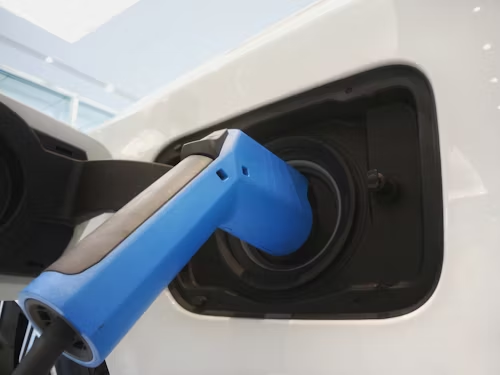
Once installed, maintenance focuses on battery health checks, software updates, and ensuring the charging cable remains in good condition. Regularly monitoring state‑of‑charge and temperature helps catch issues early.
Long‑term value considerations
- Projected fuel savings versus initial cost over a 7–10 year horizon – include potential increases in electricity rates and any future tax credits.
- Residual value of the vehicle after conversion – converted cars often retain higher resale values, especially as demand for used EVs rises.
- Potential resale market for converted vehicles in Irvine – local dealerships are beginning to list “converted” models as a niche offering.
- Impact on insurance premiums due to lower emissions – some insurers offer discounts for certified electric or hybrid conversions.
- Availability of future upgrades (e.g., higher‑capacity batteries) – modular kits allow you to swap in newer cells without replacing the entire system.
A recent client from Irvine upgraded a 2015 Honda Civic with a hybrid conversion kit. The vehicle’s range increased from 35 miles to 120 electric miles, cutting monthly fuel costs by $60 and earning a $2,500 state rebate. The conversion took three weeks, including part sourcing, wiring, and a final calibration test conducted at an accredited service center in Irvine.
When evaluating the return on investment, factor in both tangible savings and intangible benefits like reduced emissions and improved driving experience.
Choosing a conversion that aligns with Irvine’s growing network of electric charging stations ensures you’re future‑proofing your vehicle. As the city expands its infrastructure, the value of a sustainable upgrade only grows.
What specific challenges have you faced when converting a vehicle in a California city like Irvine, and how did you address them?